Inside the Mixer: How Material Movement Determines Mixing Quality

What happens inside the mixer determines the result
An industrial mixer has a seemingly simple task: to process different components into a mixture that is as homogeneous as possible. In practice, however, this is precisely what makes it a challenging process engineering task.
This is because it is not only crucial that the material moves within the mixing chamber. What is crucial is how it moves, how frequently individual particles pass through different areas of the mixer, and what mechanical stress is generated in the process.
Material movement thus directly influences homogeneity, mixing time, energy input, and ultimately the reproducibility of the entire process.
For manufacturers, this means that good mixing performance is not achieved by the highest possible rotational speeds or the most powerful drives. It is achieved when tool geometry, material properties, and process parameters interact precisely.
Every recipe is different
Powders, granules, pigments, fillers, and additives can vary significantly in particle size, bulk density, shape, and flow behavior.
When such components are processed together, complex motion patterns develop in the mixing chamber. Some particles accelerate easily, while others react more sluggishly. Fine components may behave differently from coarse granules. Differences in bulk density can also cause components that have already been homogenized to separate again.
The purpose of the mixing system is therefore to continuously feed the entire material and repeatedly pass it through the relevant mixing zones.
Visible material movement alone is not proof of a good mix. What matters most is that as many components of the batch as possible are reliably incorporated into the process.
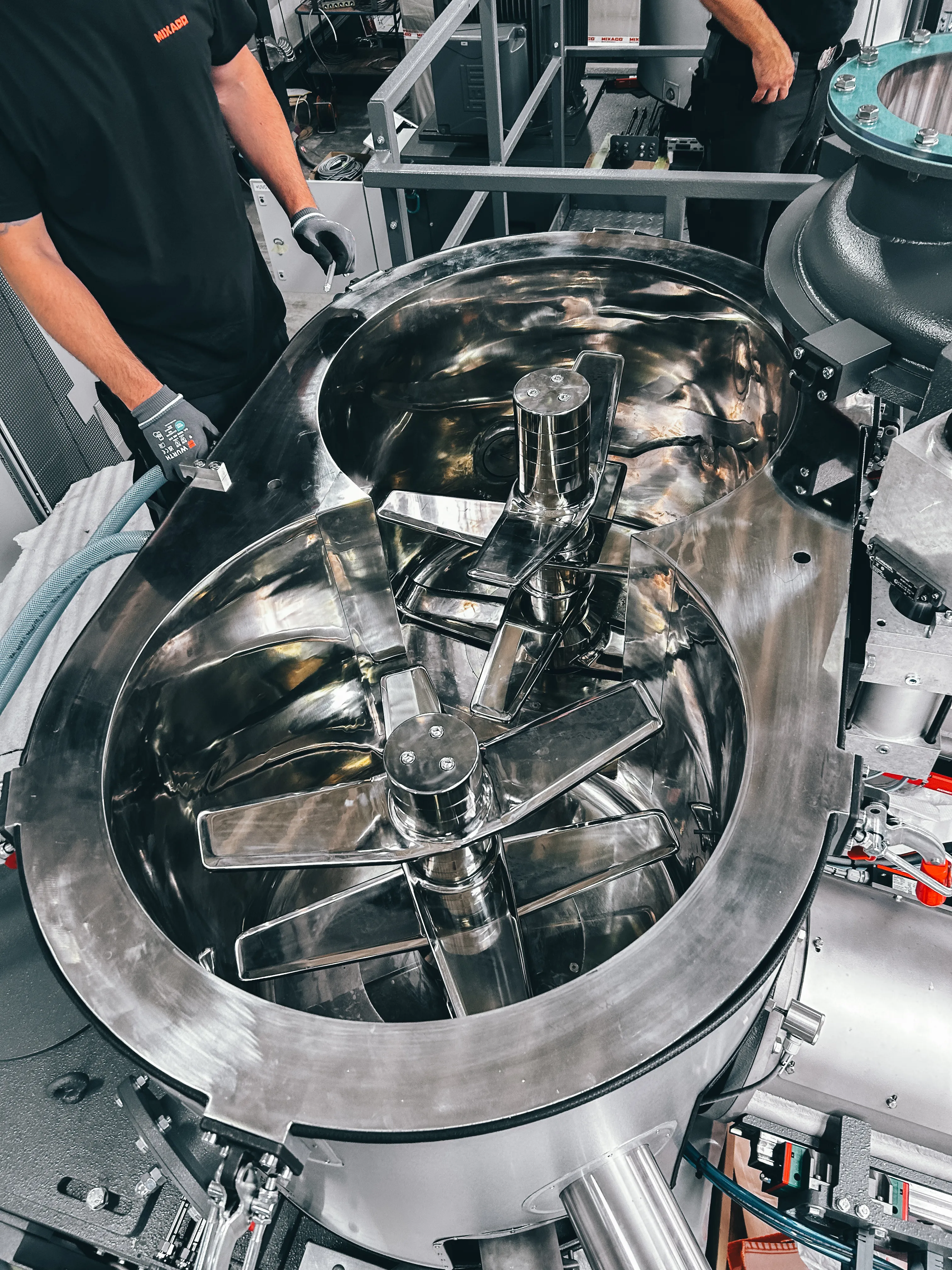
Tool geometry controls the flow of material
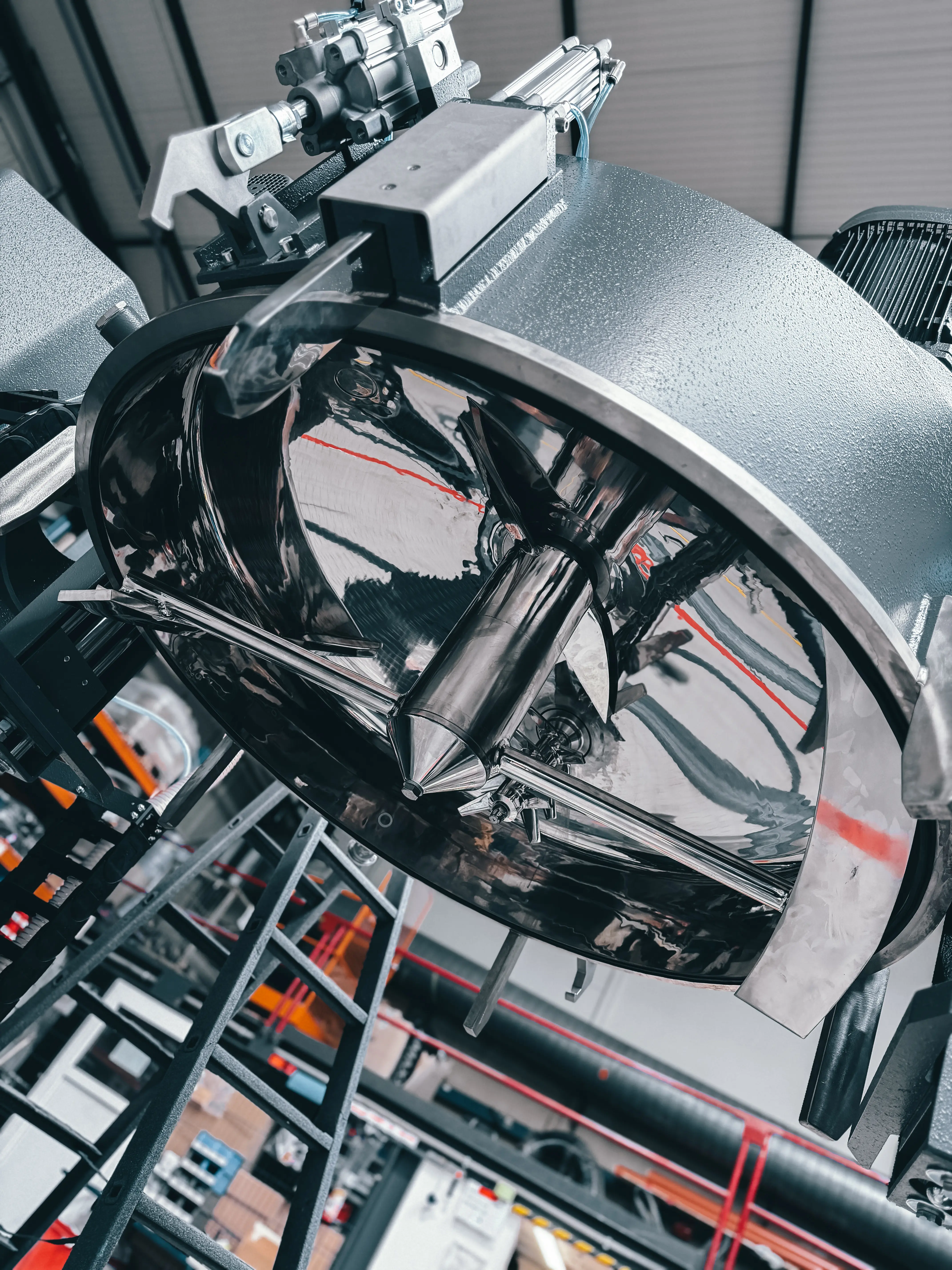
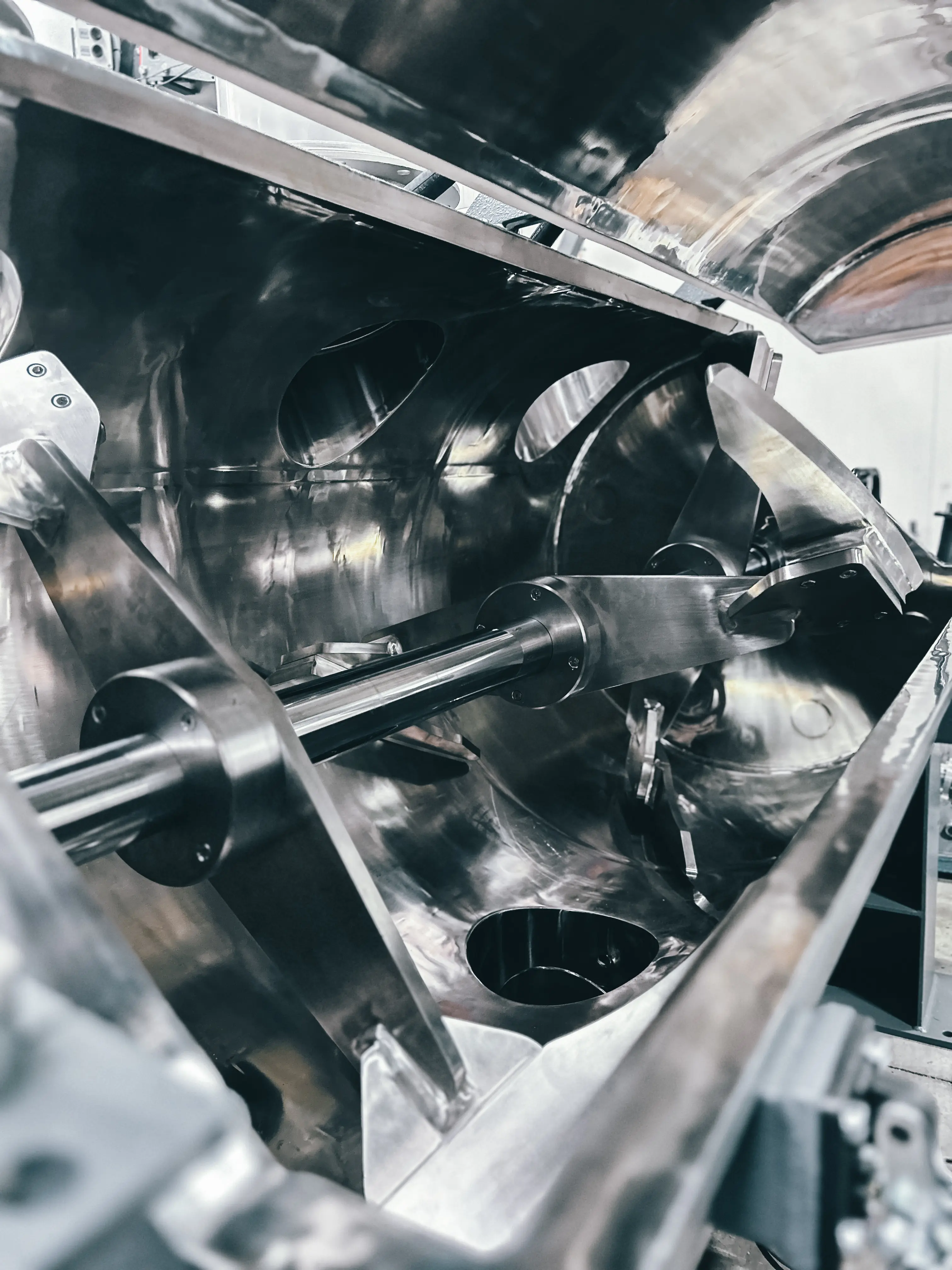
The mixing tool is one of the most important factors influencing material flow.
The shape, position, and arrangement of the tools determine how the material is accelerated, lifted, redirected, or guided into specific areas of the mixing chamber. At the same time, the tool geometry influences how mechanical energy is transferred to the product.
Depending on the application, the objective can vary significantly.
For a delicate powder mixture, the focus may be on homogenization that is as gentle as possible. For a pigmented formulation, on the other hand, more intensive distribution may be required. In other applications, agglomerates must be specifically broken up, or components with very different properties must be combined.
Therefore, there is no single optimal tool geometry for all processes.
The best solution is always the one that suits the specific formulation and the desired mixing result.
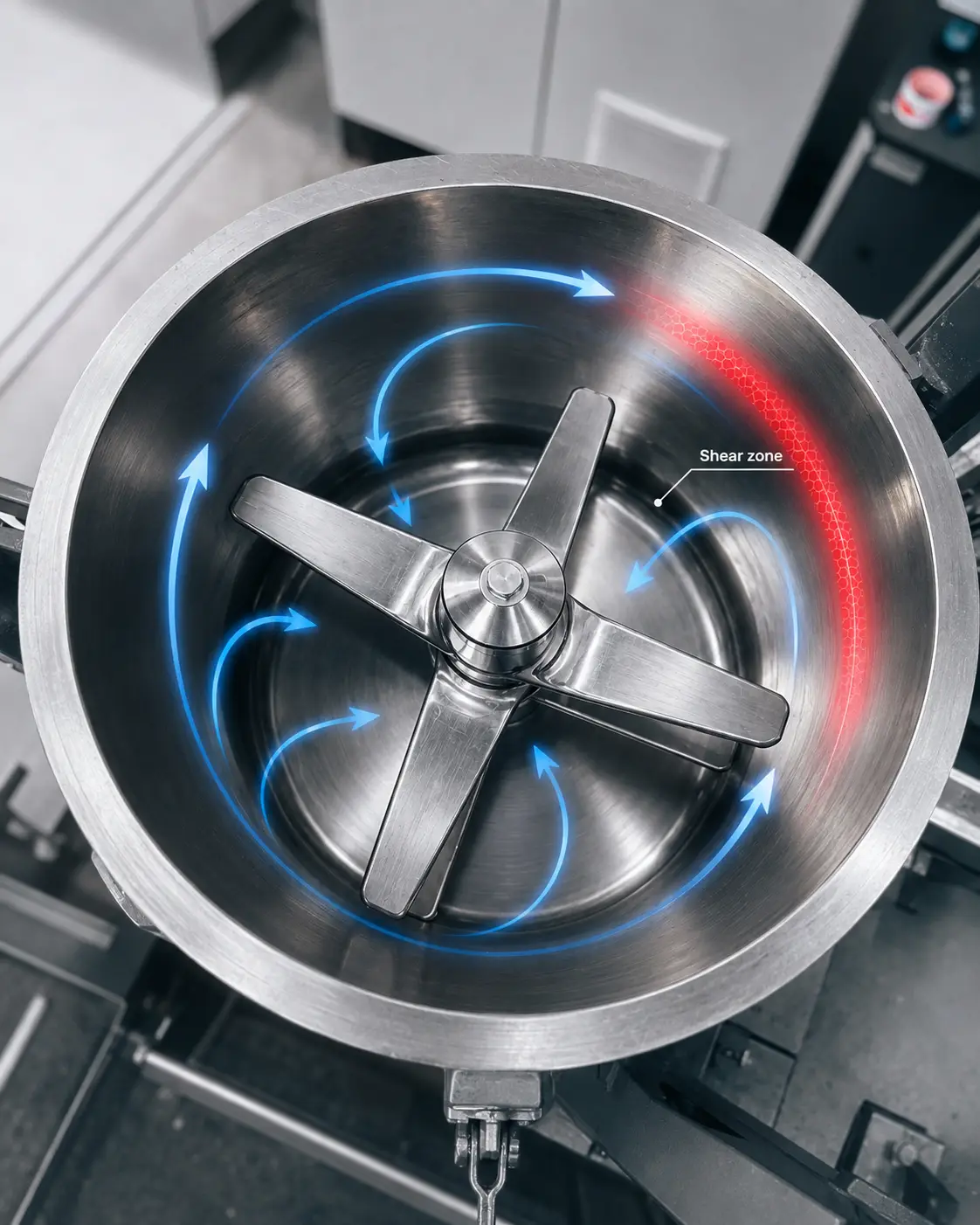
Apply shear forces where they are needed
In addition to large-scale material movement, local shear forces also play an important role.
For example, they can be used to reduce agglomerates, distribute pigments more evenly, or specifically modify certain material structures.
However, it is important to note that higher intensity does not automatically lead to a better result.
Excessive mechanical stress can alter sensitive materials, damage particle structures, or generate additional heat. Especially with temperature-sensitive products, an unnecessarily high energy input can negatively impact the entire process.
An efficient mixing solution therefore generates exactly the intensity required for the task at hand and avoids unnecessary stress on the product.
When Material Handling Leads to Better Performance
Optimized material flow doesn’t just affect product quality; it can also be crucial to the process’s cost-effectiveness.
If all components are fed through the mixing chamber more quickly and with greater precision, the desired mixing quality can, under certain circumstances, be achieved in less time.
For production, this means potentially shorter batch times and, consequently, more batches within the same production period. At the same time, an efficient process can help reduce energy consumption per unit of output.
The key point here is not simply to run the mixer faster.
Rather, it is about applying the available energy to the mixing process as precisely as possible.
An optimally balanced combination of tooling, speed, fill level, and mixing time can therefore make a significant difference between a process that merely works and one that is truly efficient.
Different processes require different material flows
At MIXACO, we therefore do not view the mixer as an isolated machine.
The machine design, tool geometry, and process parameters are jointly tailored to the specific application.
Depending on the process, intensive material circulation may be required. In other cases, the focus is on controlled temperature regulation, gentle homogenization, or targeted shear forces.
The fill ratio also plays an important role. This is because even an optimally designed mold geometry can only achieve its full potential if there is sufficient material in the intended working area and the desired material movement actually occurs.
The interplay of these factors determines how efficiently the mixer operates and how reliably the results can be reproduced from batch to batch.
The optimal mixing process begins with the material
Theoretical calculations and many years of experience form an important basis for the design of a mixing process. Nevertheless, the actual behavior of a formulation can only be fully assessed during the actual mixing process.
That is exactly why mixing trials play a central role at MIXACO.
At the MIXACO Test Center, customers can process their own materials under realistic conditions. This allows them to test different tool configurations, rotational speeds, fill levels, and mixing times.
In addition to the actual mixing result, our application experts also examine the process itself. How does the material move? How does the temperature change? How quickly is the desired homogeneity achieved? And which settings offer the best balance between product quality, process time, and energy input?
Based on these findings, a mixing solution is developed that not only works from a technical standpoint but is also specifically tailored to future production.
Not just any mixer, but the right process
For us, a good mixing solution therefore does not begin with the question of which machine can be sold.
It begins with the question of what the customer wants to achieve with their material.
Only once material properties, quality requirements, and production goals are understood can we assess what kind of material movement is required and which machine design can best achieve it.
For us, this is precisely the difference between a mixer and a mixing solution that is truly tailored to the process.
Would you like to know how your materials behave during the mixing process and which machine configuration offers the best performance for your application?
At the MIXACO Test Center, you can test your own materials free of charge. Together with our application experts, we’ll develop the right process parameters and the appropriate mixing solution for your requirements.
Learn more about our productsFor further information please do not hesitate to contact us.
MIXACO
Dr. Herfeld GmbH & Co. KG
Niederheide 2
58809 Neuenrade
Germany
+49 (0)2392 96440
sales@mixaco.de